Wednesday, April 8, 2020

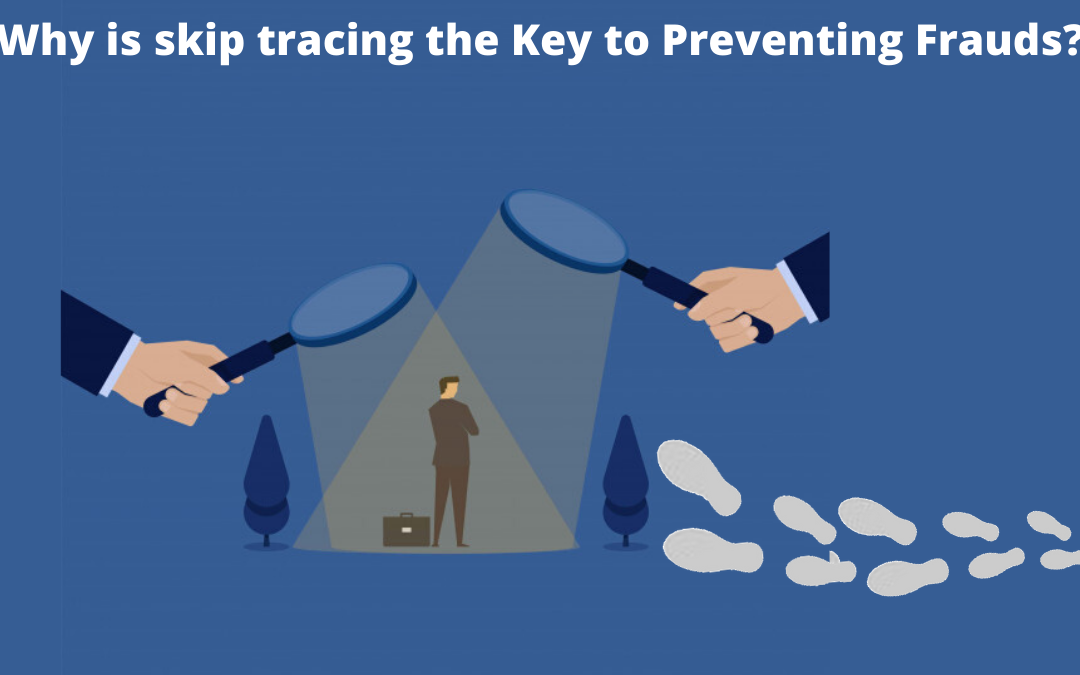
Why is skip tracing the Key to Preventing Frauds?


Most businesses operate on trust with the debts and credits being an integral part of their functioning. However, this also exposes you to the risk of frauds that can leave you in great financial devastation. Many businesses have even gone insolvent because of bad debts. In recent times similar incidents have happened with well-established banks. Fraud cases like these have left their existence in jeopardy. These incidents often occur when the debtors go missing and do not payback. In such situations, if you can find the debtor, the potential of getting paid is increased several times. Skip tracing services do precisely the same for you.

Skip tracing is a process of locating a missing person who is trying to hide to avoid paying back the debt. The missing debtor or the debt seeker is the person of interest and is called the skip and the process of locating the skip is called skip tracing. Skip tracing services are among the most critical components in any collection environment. Many surveys have revealed that nearly 40% to 60% accounts of the consumers in the collection industry do not have point-of-contact information. The above fact necessitates the need for the development of skip trace skill sets in your employees to reduce the devastating effects of missing debtors.

Growth of skip tracing is an essential tool to prevent bamboozlement


In yesteryears, it was relatively easy for the debtors to leave the town or the country and default on their financial obligations. This way, they were able to avoid collection attempts and leave no option for their creditors but to skip trace them. Traditional methods of skip tracing were manual. Surveys have shown that 38% of the collectors take over two weeks to pinpoint the subject. In the present time, collectors have a wide range of resources at their disposal. You can implement technologies and use databases to find the right party contact.

A typical skip tracing process contains three primary phases. Whether you want to confirm the credibility of an individual or business or trying to trace a missing defaulter, the best practice is to break down your search into the following steps.


From Visually.

Categorizing the person of interest


The first step is to take the information by the subject. The subject often gives this information at the beginning of the deal. Using this information, you establish the essential identity of the subject.

Search refinement


Next is to verify the information collected in the first step and ensure that you are looking for the right party.

Information gathering and tracing


Having the necessary data, you can proceed to find detailed information about the subject from different databases and resources and find your person of interest.

Information from phone number databases, automobile records, GPS data, social media (Facebook, LinkedIn, Instagram, etc.), web searches, loan applications, job applications, property documents, public record databases, bank records, etc. can be used to locate the person of interest. Most of these databases and information sets are available electronically and can be accessed using data mining services. Nearly 95% of collectors agree that these latest technologies and databases have improved their search for the right-party contact significantly.

Several surveys conducted indicate that an average of 83% collectors who have their employees trained in the data mining services and skip tracing can locate their skips in just a few minutes. They can find the real-time location of the debtors and contact their friends, relatives, neighbours, and colleagues to find their information and verify. The new age skip tracing services has tremendously accelerated the process and has become a primary tool to find the defaulters and prevent frauds.

How skip tracing helps in preventing and resolving frauds?


Information about the individuals is the most vital resource to control and prevent frauds for the businesses who deal with credits. Skip tracing is an excellent way to gather maximum information about the person of interest. Earlier, skip tracing used to be a tool to find the missing debtors. However, in the present day and age, it is used more proactively. Businesses are using these tools to gather information before sanctioning the credits to assess the credibility of the debtor. These tools are also useful in judging the possibility of the repayment of the amount. This helps in curbing the possibility of frauds and increasing the likelihood of locating the defaulters for recovery. Skip tracing has become an inevitable part of many industries. Here are some ways skip tracing helps in curbing the fraudulence.
skip tracing resolving frauds


Information in a cost-effective way


Information is the key to curb cheating cases. Skip tracing uses the newest technologies to gather data more accurately and quickly. This saves a lot of time and money for the tracers. Information like location, activities, address, email address, contact number, etc. can be found on the internet using social media without nearly no financial investment. This helps in verifying the information submitted by the subject and helps in early identification of the people who are trying to or can possibly conduct a fraud. You can remove such people from your organization or do not recruit them in the first place.  Social media accounts are also a fantastic way to get in touch with the people related to the missing person and enquire about his/her location. When so much information is at your fingertips and can be accessed within no time, it becomes easier to find the defaulters. This also discourages people from attempting frauds.

Establish the need for private investigation


Conducting a private investigation or hiring a private investigator to look into your business’s matter can be expensive. If you have your employees trained to skip tracing, you will be able to handle frauds without making that investment. Also hiring professional skip tracers can be more productive and less expensive than private investigators. This lends a high helping hand for businesses that are running on limited liquid resources and deals in the lending and collection industry.

Access control and performance enhancement


In the modern business environment, business frauds are not limited to debt defaulters. Businesses are working with unique assets like confidential information and valuable data. These assets are vulnerable even within the company. With skip tracing, you can implement better control on the accessibility and search criteria. Also, it helps you find the right-party with greater accuracy. You have better control over your search and are more likely to track down the right person. It enhances the performance of the entire collection process.

Help in data scrubbing


data scrubbing

To prevent frauds and efficiently find the deceivers, it is essential to have accurate and precise information. Often scams go uncovered or unresolved due to inaccurate, redundant, and ambiguous information. Such information is misleading and takes you nowhere in your investigation about a person. Misinformation about a person can lead you in wrongly believing the authenticity of the person. This can increase the chances of frauds instead of preventing it.

One of the crucial aspects of skip tracing is data scrubbing. It refines your databases by monitoring, flagging, and scrubbing the data. This can be done for data related to individuals as well as businesses you are working with and helps you achieve results more economically and accurately in much less time.


Assist in serving court documents


Frauds often lead to lawsuits which require you to present or confirm the identity and address of the person(s) involved. With skip tracing, you can get trusted and precise information and can personally serve it to the court. This can considerably speed up the trail and increase your chances to get the losses repaid.


We at BizProspex have 5 plus years of experience at providing Data scraping services, email address searchEmail data validationemail address validationemail verificationdata scrubbing servicesdata appendingemail appending servicesdata verificationweb scraping services and have garnered much trust from some of the most elite clients. Over the years we have perfected the art of skip tracing for our clients. Our clients have trusted us time and again and every time our results have met their due expectations. We have a dedicated and highly specialized team for performing the Skip Tracing. Our methods are agile and communication is one of our key components at providing the best possible results to our clients. If you are looking for the best in class skip tracing service, contact us now!

Monday, March 30, 2020

Salesforce Data.com: Why is it shut down now and what to do next?

Salesforce discontinued data.com, which was reportedly making money for the company by offering qualified leads to the businesses. And if you are wondering and still trying to make sense of what happened, here’s why the leading cloud-based CRM services provider decided to pull the plug on its sales and B2Blead generation component. It seems like the end of an era, but a logical conclusion to a technology solution that has served its purpose and outlived its utility.  

What is Salesforce Data.com?

According to its official website, Data.com is the first complete and native data solution inside Salesforce. Conceived with Dun & Bradstreet, the company scraps off the internet to build a contact list. The Salesforce CRM tools can access this contact list for workflow automation, email automation and marketing automation. 
The company offers data mining services and data scrubbing services to businesses to maintain and update this data.  The clean, reliable and qualitative data enables businesses to generate actionable insights and empowers them to stay ahead of the curve. The services of Data.com are classified into two segments, namely Clean and Prospector. 

Salesforce Data.Com Clean

The Salesforce Clean boasts of powerful data verification tools that improve the quality of contact and lead data, enrich it further by adding relevant and target-specific details to it. The entire process, right from data appending to data scraping takes place inside Salesforce via Data.com

Salesforce Data.Com Prospector

The Prospector is native to Salesforce and is a tool used to search or filter through the target. Since the businesses are targeting a specific set of customers, the pipeline is much faster, bottlenecks are reduced, and the connection to the customers is more streamlined. The outreach program becomes more aligned to the marketing objective. The Prospector offers you a 360-degree view of sales and marketing processes right within Salesforce.
According to Salesforce, the existing connects within the system will be used to maintain the Data.com towards the end-of-life. Once it is achieved (by 2020), the contact database will be archived and will no longer be in use. 
While the licenses of Prospector and Clean can’t be renewed now, these tools are slated to go out of circulation entirely and retire on July 31, 2020.

The journey of Salesforce Data.Com

Data.com came into being with Salesforce’s acquisition of Jigsaw. Even before this collab, Jigsaw was considered to be a quality tool that enabled businesses and sellers to democratise crowd-sourced data from different sources such as tax, mailing records, events or tradeshows. Businesses could exchange their compiled data and make the most of it. 
Rechristened as Data.com, the Jigsaw’s democratisation of data appears to feel like more of an afterthought that was on the way to become irrelevant sooner than you might think. The advent of social media, especially LinkedIn, the sellers are getting better at contact sourcing and contacting the person directly without the circuitous routes of a lead generation portal.  Then, there were targeted email marketing campaigns that emphasised on personalisation, whereas data.com provided contacts for mass-mailing and which were company-centric. The businesses, however, moved on to a proved ROI-based strategy where they communicated with buyers and companies that are the perfect fit for their business and services. The ROI-oriented account-based tools and not the ones handing out contacts is the need of the hour. 
Since last year, it has stopped taking new customers. However, it is not the only one. Other big data and data mining services providers such as Salesloft’s Prospector, KiteDesk have closed the doors for new customers too. B2B companies and sales reps that relied heavily on contact data provided by the Data.com are still trying to understand the ‘whys’ and ‘whats’, and we help them find out exactly that! 
One among the many reasons that Salesforce decided to call it quits with Data.com was to abide by the European Union’s General Data Protection Regulation (GDPR) that brings crowd-sourced data under the scanner. According to this law, “Organisations found breaching the GDPR can be fined up to four per cent of annual global turnover or an amount of €20 Million (whichever is greater).” 
 It is the maximum fine that can be levied upon the businesses that don’t adhere to most serious infringement yet the basic requirements of an outreach campaign such as having sufficient consent from the customer to use their data. Crowd-sourced data comes without any liability and is often duplicated. Once it enters into a system, it is difficult to ensure its hygiene. Regular CRM data cleaning and various checkpoints are the ways to keep data current and complete. 
Besides, there are several data mining tools available in the market as opposed to when Salesforce started. While marketing automation has still a long way to go, the businesses now have a variety of tools outside the periphery of Salesforce while being highly compatible and platform-agnostic. The lack of new features to accommodate targeted and micro focussed marketing campaigns also contributed to its demise.  
As social sourcing the contact becomes the widely-accepted form of lead generation, account-based selling takes the place of mass mailing, stringent laws for outreach campaign come into being, and businesses look beyond the CRM for data solutions, Salesforce has no option but to shut down Data.com

Nonsensical and Irresponsible Data Sanitation Practices

Data.com gained popularity for leading the way forward to the democratic availability of data. However, the idea of ‘of the people, by the people and for the people’ didn’t work out well. There were no sanity checks to the data uploaded, the data scrubbing practices were non-existent, and users could upload any data lists that they want. Experts like Neil Patel have always emphasised on the importance of paying attention to the origin of data rather than building an overloaded system. However, companies often fail to understand the 101 of data quality. Salespeople forget the core principle of their work that it is ever-evolving. People tend to change their jobs, address and email IDs, but the changed details rarely make it to the contact list. 
When businesses hire a third-party database, the CRM gets inundated with outdated, duplicated and incomplete data.  So, it shouldn’t come as a surprise that a sales rep end up wasting more than 546 working hours in a year owing to the bad data in the system. 

Lack of regulatory practices

Data.com was cool for businesses before the latter realised its uncool lack and utter disregard for personalisation and data mining services. An outreach campaign to reach out to your customers isn’t about sending the same mail to an odd list of 10,000 people (Fact check: it is spam).  It is about connecting with the customers they want it or the way they would prefer. So, when this data prospecting tool closes down completely, it shouldn’t come as a surprise.  Missing fields, duplicate data, invalid formatting and invalid values just add to the madness of crowd-source data. Here’s just a sneak peek at enterprise lead disposition for busiinesses, showcasing the impact of poor quality data on B2B lead generation.

Salesforce discontinued data.com, which was reportedly making money for the company by offering qualified leads to the businesses. And if you are wondering and still trying to make sense of what happened, here’s why the leading cloud-based CRM services provider decided to pull the plug on its sales and B2Blead generation component. It seems like the end of an era, but a logical conclusion to a technology solution that has served its purpose and outlived its utility.  

What is Salesforce Data.com?

According to its official website, Data.com is the first complete and native data solution inside Salesforce. Conceived with Dun & Bradstreet, the company scraps off the internet to build a contact list. The Salesforce CRM tools can access this contact list for workflow automation, email automation and marketing automation. 
The company offers data mining services and data scrubbing services to businesses to maintain and update this data.  The clean, reliable and qualitative data enables businesses to generate actionable insights and empowers them to stay ahead of the curve. The services of Data.com are classified into two segments, namely Clean and Prospector. 

Salesforce Data.Com Clean

The Salesforce Clean boasts of powerful data verification tools that improve the quality of contact and lead data, enrich it further by adding relevant and target-specific details to it. The entire process, right from data appending to data scraping takes place inside Salesforce via Data.com

Salesforce Data.Com Prospector

The Prospector is native to Salesforce and is a tool used to search or filter through the target. Since the businesses are targeting a specific set of customers, the pipeline is much faster, bottlenecks are reduced, and the connection to the customers is more streamlined. The outreach program becomes more aligned to the marketing objective. The Prospector offers you a 360-degree view of sales and marketing processes right within Salesforce.
According to Salesforce, the existing connects within the system will be used to maintain the Data.com towards the end-of-life. Once it is achieved (by 2020), the contact database will be archived and will no longer be in use. 
While the licenses of Prospector and Clean can’t be renewed now, these tools are slated to go out of circulation entirely and retire on July 31, 2020.

The journey of Salesforce Data.Com

Data.com came into being with Salesforce’s acquisition of Jigsaw. Even before this collab, Jigsaw was considered to be a quality tool that enabled businesses and sellers to democratise crowd-sourced data from different sources such as tax, mailing records, events or tradeshows. Businesses could exchange their compiled data and make the most of it. 
Rechristened as Data.com, the Jigsaw’s democratisation of data appears to feel like more of an afterthought that was on the way to become irrelevant sooner than you might think. The advent of social media, especially LinkedIn, the sellers are getting better at contact sourcing and contacting the person directly without the circuitous routes of a lead generation portal.  Then, there were targeted email marketing campaigns that emphasised on personalisation, whereas data.com provided contacts for mass-mailing and which were company-centric. The businesses, however, moved on to a proved ROI-based strategy where they communicated with buyers and companies that are the perfect fit for their business and services. The ROI-oriented account-based tools and not the ones handing out contacts is the need of the hour. 
Since last year, it has stopped taking new customers. However, it is not the only one. Other big data and data mining services providers such as Salesloft’s Prospector, KiteDesk have closed the doors for new customers too. B2B companies and sales reps that relied heavily on contact data provided by the Data.com are still trying to understand the ‘whys’ and ‘whats’, and we help them find out exactly that! 
One among the many reasons that Salesforce decided to call it quits with Data.com was to abide by the European Union’s General Data Protection Regulation (GDPR) that brings crowd-sourced data under the scanner. According to this law, “Organisations found breaching the GDPR can be fined up to four per cent of annual global turnover or an amount of €20 Million (whichever is greater).” 
 It is the maximum fine that can be levied upon the businesses that don’t adhere to most serious infringement yet the basic requirements of an outreach campaign such as having sufficient consent from the customer to use their data. Crowd-sourced data comes without any liability and is often duplicated. Once it enters into a system, it is difficult to ensure its hygiene. Regular CRM data cleaning and various checkpoints are the ways to keep data current and complete. 
Besides, there are several data mining tools available in the market as opposed to when Salesforce started. While marketing automation has still a long way to go, the businesses now have a variety of tools outside the periphery of Salesforce while being highly compatible and platform-agnostic. The lack of new features to accommodate targeted and micro focussed marketing campaigns also contributed to its demise.  
As social sourcing the contact becomes the widely-accepted form of lead generation, account-based selling takes the place of mass mailing, stringent laws for outreach campaign come into being, and businesses look beyond the CRM for data solutions, Salesforce has no option but to shut down Data.com

Nonsensical and Irresponsible Data Sanitation Practices

Data.com gained popularity for leading the way forward to the democratic availability of data. However, the idea of ‘of the people, by the people and for the people’ didn’t work out well. There were no sanity checks to the data uploaded, the data scrubbing practices were non-existent, and users could upload any data lists that they want. Experts like Neil Patel have always emphasised on the importance of paying attention to the origin of data rather than building an overloaded system. However, companies often fail to understand the 101 of data quality. Salespeople forget the core principle of their work that it is ever-evolving. People tend to change their jobs, address and email IDs, but the changed details rarely make it to the contact list. 
When businesses hire a third-party database, the CRM gets inundated with outdated, duplicated and incomplete data.  So, it shouldn’t come as a surprise that a sales rep end up wasting more than 546 working hours in a year owing to the bad data in the system. 

Lack of regulatory practices

Data.com was cool for businesses before the latter realised its uncool lack and utter disregard for personalisation and data mining services. An outreach campaign to reach out to your customers isn’t about sending the same mail to an odd list of 10,000 people (Fact check: it is spam).  It is about connecting with the customers they want it or the way they would prefer. So, when this data prospecting tool closes down completely, it shouldn’t come as a surprise.  Missing fields, duplicate data, invalid formatting and invalid values just add to the madness of crowd-source data. Here’s just a sneak peek at enterprise lead disposition for businesses, showcasing the impact of poor quality data on B2B lead generation.

The lack of reinventing

Companies, these days, are thriving on data and focus on making a data-oriented system for their business processes. However, it is the quality of data that often gets overlooked.  The email marketing campaigns are now interactive, more personalised and tend to serve a niche target segment. Cold calling or emailing is still relevant, but it is also quality over quantity. If only Data.com had reinvented its practices and had adopted a proactive approach towards email appending and data scrubbing, we wouldn’t be here talking about the downfall of it. 

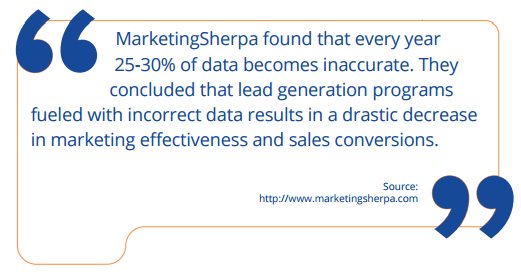
A salesperson making an unintentional typo while entering the details in the system, not following the format, or a customer changing a job – it all leads to unstructured and poor-quality data.  According to this research by Marketing Sherpa, every year, up to thirty per cent of data becomes inadequate and inaccurate. At the same time, businesses do nothing about it but continue to base their business decisions on it.
Bad CRM data leads to higher bounce rates of email, inaccurate details of customers result in poor business decisions, wasted time and efforts. The practice of keeping data up-to-date is rare than you might think despite its criticality. 
At times when companies are opening up to nudge-based user personas, buyer behaviour, social listening and predictive analysis, data is what drives them all and quality data is non-negotiable. However, Data.com scored a big ZERO when it came to offering relevant and current data to its clients – the only job that it had.

So, what to do now?

Data.com is gone, and with it being out of the picture, you need to find data appending companies that adhere to international CAN-SPAM regulations and have data appending services in place. A data solution provider that takes the ownership of the data it is provided to you and ensures it is updated, complete and accurate. It should offer value-based solutions such as CRM cleaning, email data validationemail verificationemail address validation and scrubbing simultaneously to ensure that the data is checked and looked into for discrepancies at various checkpoints, especially when it enters into the system. 
Accurate, verified, and targeted contact data is the need of the hour. Your salespeople shouldn’t spend their time double-verifying email address details off the social media or finding out the right information for a targeted segment when you have already paid for it. 

Friday, March 13, 2020

Now Save Time and Money with This New Way- Skip tracing for Banking and Finance!


The concept of skip tracing comes from an age-old phenomenon of finding something new or finding something which was lost. Human beings have an inherent desire for exploring unknown and unravelling it. Therefore, skip tracing is a term which we have formulated to describe the human need of unravelling the unknowns. In the world, as we know it today, skip tracing has taken multiple forms. Also, since the internet has become a part of our lifestyle, skip tracing is also done on the virtual platform of the internet.

Skip Tracing – Unravel the Unknown


The world is full of information which we can call data. There is a famous modern saying “Anything uploaded on the internet stays forever.” We are uploading lots of data on the internet everyday – sometimes deliberately and sometimes without even realizing it. Even a simple Google survey form that we fill is capable of giving away a lot of crucial information about us. Honestly, our lives are not so private anymore. We all are leaving digital footprints everywhere on the internet. These digital footprints are utilized for innumerable purposes by both positive and negative elements present in the modern world today.

Skip tracing is often used by fraudsters and cyber criminals to trace confidential information about any individual. They use this information to fulfill their dirty motives and satisfy their greed.

As a preventive measure, the banking and finance industry often use Skip Tracing to trace debtors, fraudsters in order to gather information about them. Thus, just like every coin has two sides, Skip Tracing is used for both positive and negative purposes.

What is Skip Tracing in the digital era?


Skip Tracing is a method of finding the right addresses of the clients or the debtors who have absconded to avoid paying the debts. In the internet realm, skip tracing is an art of finding the right address of the person in charge by tracing their digital footprints. Data on the internet is highly sublime. Currently, the decay rate across all the industries is close to 30% annually. Thus, the information on the internet is constantly getting irrelevant or incorrect. It is important to update the information continuously to avoid any major mishappenings and also to maintain the sanctity of the data.

Skip Tracing particularly becomes very crucial in the banking and finance industries as both the industries require highest level of accuracy when it comes to customer data. Further, both industries are highly susceptible to crimes. Thus, skip tracing plays a crucial role in the banking and finance segment.

Why Banking and Finance industry need Skip Tracing?


In news published in Financial Express it was stated that Indian Overseas Bank (IOB) has recovered a sum of 74.60 crores with the help of skip tracing. The amount was recovered from retail borrowers between January and May 2019. It may seem like a small sum on a global level but in a third world nation like India, it can be considered as a huge amount.

Skip Tracing is a way of finding addresses of the defaulters, debtors who have disappeared without a ‘trace’. These defaulters often owe a huge sum to the banks but have eloped in order to avoid paying debts. Due to the economic slowdown and dipping morals of human beings these days, people tend to find shortcuts to avoid the problems rather than solving them. People lose jobs, fail to pay their credit card dues, default on their house loans or personal loans all the time. Thus, deploying skip tracing services has become quite a norm for banks these days.

The Skip Tracing Process


A lot has been discussed about Skip Tracing and why does Banking and Finance Industries need skip tracing. However, we also need to know the process behind Skip Tracing to fully understand its importance and need. In the following article, we further discuss in detail the complete process behind Skip Tracing.

Skip Tracing is not an easy process. It is a multi-layered, multi-faceted process which takes into consideration a lot of factors. The customer information is firstly verified from multi sources and if the information found is misleading only then rigorous Skip Tracing methods are brought in to action. Therefore, Skip Tracing can be broadly broken down into the following steps:

1. Identify the Defaulters/ Debtors


The first step involved in the process of Skip tracing is identifying the debtors or defaulters. The bank shares its database with us. With the help of our Skip Tracing database we identify the anomalies in the data. We later match this anomaly with the record and identify the defaulters. We communicate the found information to the bank to further confirm our doubts about the defaulters. Once we know how the defaulters are we carry out research to find out the missing or changed information about them.

2. Verify the data from multiple sources


We verify the customer’s data from multiple resources or platforms. We leave no stone unturned at following the digital trails left behind the defaulters. We cross verify their personal information from various sources and platforms:

We carry out Google String search:


When it comes to tracing someone online who can be rather trusted than Google itself. Keeping this basic mantra in mind, we verify the customer’s information by carrying out Google string search. Though it may sound superficial but the results that we get with the help of Google search is often astounding!

 Social Media Accounts – Facebook, LinkedIn and others:


Just to double check and re-verify we also look up the customer’s address and other information on social media sites like Facebook and LinkedIn. Social media has become a strong tool for tracing the addresses and finding out crucial information about any person. Social media sites not just give out the address of the person but also their personal information such as job profile, date of birth, phone number which can come handy for banks and finance industries.

Email Checkers:


We have a tried and tested email checker tool which checks and verifies the email addresses of people. With the help of email checkers we can verify the email addresses of the customers and sometimes all we need is the email address to find and contact the customer.

Look up at public directories:


We look up for the right address at the public directories available online or otherwise. We also have our own master database which consists of data about people living at various demographics. We compare the customer’s information from our master database and verify it.

Reverse Search Sites:


There are several reverse search sites into the existence which can verify the information about the person in question. The website only requires the first name and the last name along with some information like phone number. The job of these websites is to use the given information and match it to the address of that person. Thus, reverse search sites can also be used to verify the address of the clients or customers.

Conclusion


The more accurate you are with your information, lesser are the chances of frauds or other mishaps. Thus, skip tracing is a must opted for service in today’s time. All the major banks and finance industries use skip tracing methods in order to trace information about their clients. We also have some facts to present here:

1.    98% believe that Skip Tracing helps them to collect information in the most accurate way possible.
2.    95% have improved their contact rate with the help of advance Skip tracing methods.
3.    83% no longer have to fear finding contacts and can find contacts within minutes with the help of advance skip tracing methods.
4.    Without Skip Tracing techniques, it requires more than two weeks on average to locate the address of any defaulter or fraudster.
5.     

We at BizProspex have 5 plus years of experience at providing Skip Tracing services, email address search, data mining servicesdata scrubbingdata appendingemail appending servicesdata verificationweb scraping services and have garnered much trust from some of the most elite clients. Over the years we have perfected the art of skip tracing for our clients. Our clients have trusted us time and again and every time our results have met their due expectations. We have a dedicated and highly specialized team for performing the Skip Tracing. Our methods are agile and communication is one of our key components at providing the best possible results to our clients. If you are looking for the best in class skip tracing service, contact us now!